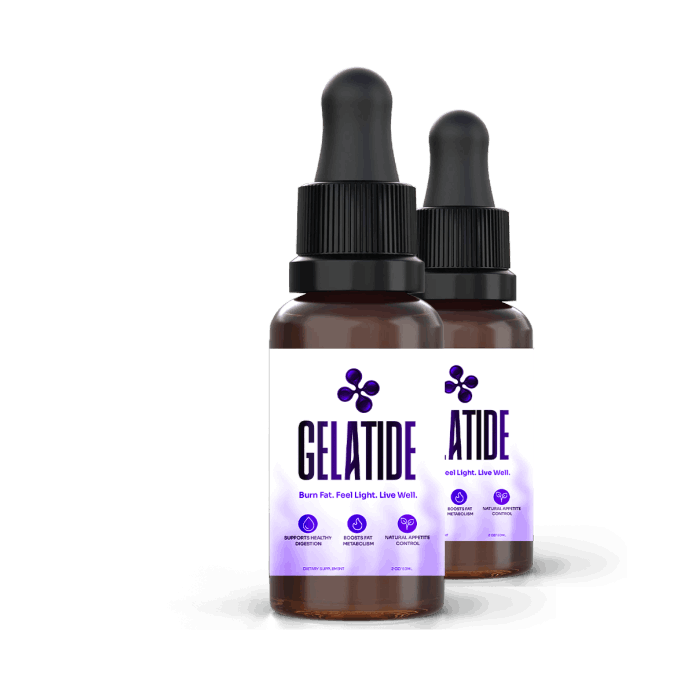
Gelatide is a liquid appetite-control supplement taken from a dropper — six botanicals, each named in full with its Latin binomial, under three label claims: supports healthy digestion, boosts fat metabolism, natural appetite control. This page covers what's disclosed, what isn't, what the underlying research says about each ingredient, and where the pricing and guarantee actually stand.
Written from the bottle label, the seller's own listing, and the published research on each named ingredient — not a lab test of this specific bottle, and not a clinical trial of the finished product.
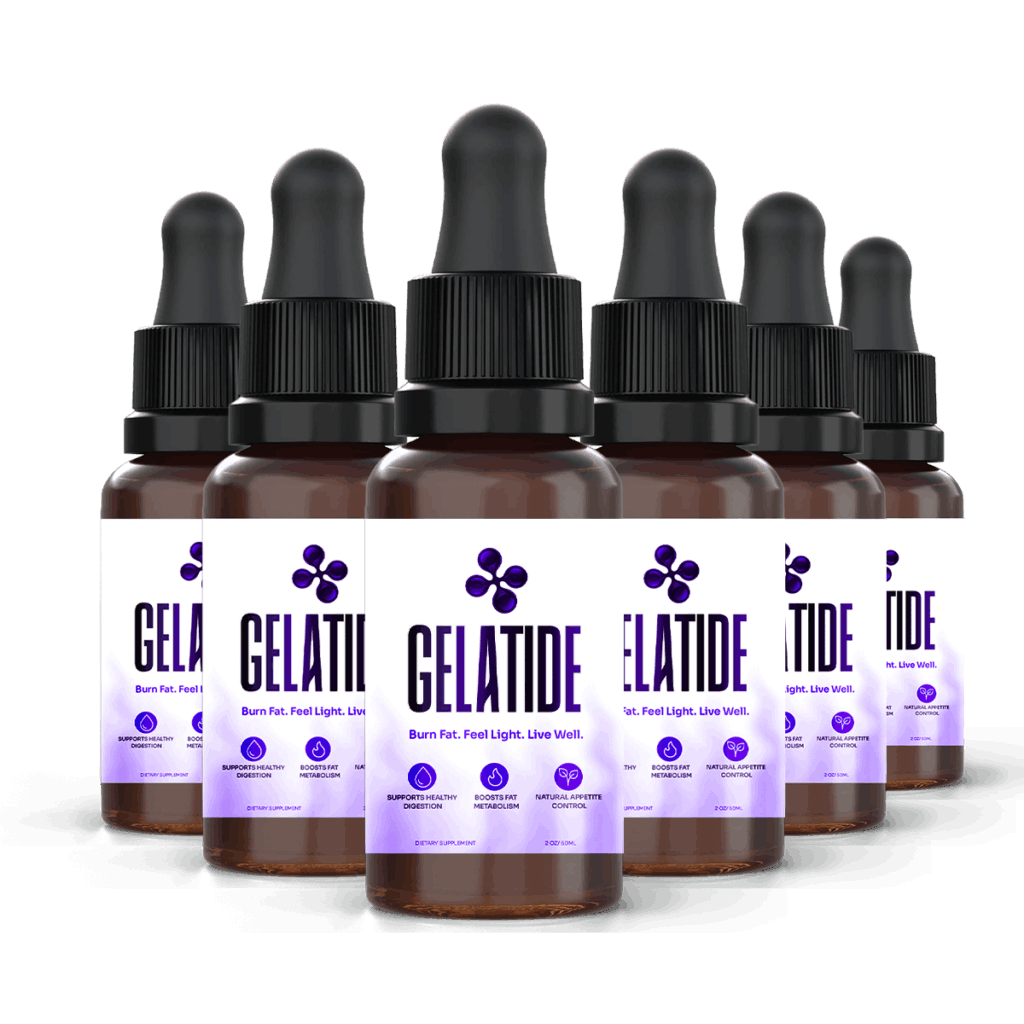
Gelatide is a liquid dietary supplement, 2 fl oz (60 mL) of amber glass with a rubber-bulb dropper in the cap. A serving goes under the tongue or into a glass of water in the morning. There's no capsule shell to swallow and no proprietary blend name hiding what's inside — six botanicals, each printed with its full Latin binomial.
Three lines run across the front label, and they're the whole of what the product claims: Supports Healthy Digestion, Boosts Fat Metabolism, Natural Appetite Control. Each describes a bodily process rather than promising a specific outcome — the kind of claim a dietary supplement is legally permitted to make without pre-approval.
Each is printed with its full Latin binomial — a genuine point in Gelatide's favor compared to an unnamed "proprietary blend."
| Extract | What It Is | Why It's On The Label |
|---|---|---|
| Green Tea Leaf Camellia sinensis | Catechin Source | The deepest trial record of the six; catechins are what the digestion and metabolism claims mostly lean on. Caffeine-bearing. |
| Guarana Seed Paullinia cupana | Caffeine Source | An Amazonian seed running 2-4x the caffeine of coffee bean by weight — the alertness half of a morning serving. |
| African Mango Seed Irvingia gabonensis | Appetite Botanical | A West African seed extract carrying most of the appetite marketing in this category, on a short and contested research record. |
| Coleus Forskohlii Root Plectranthus barbatus | Metabolism Route | The root forskolin is drawn from. Forskolin raises cyclic AMP in cells — the mechanism behind the fat-metabolism claim. |
| Capsicum Annuum Fruit Capsicum annuum | Thermogenic | Red pepper extract, the capsaicinoid source. The one ingredient here with a meta-analysis specifically aimed at food intake. |
| Raspberry Ketones | Aroma Compound | The compound that makes raspberries smell like raspberries. A long-standing category inclusion, and the thinnest evidence on the panel. |
None of these figures describe this bottle — they describe what a working amount looked like in a published trial of that ingredient alone.
| Extract | Amount Used In Research |
|---|---|
| Green tea leaf | 270 to 1,200 mg of catechins a day, pooled across trials |
| Guarana seed | 50 to 75 mg of dried extract a day in the cited fatigue trial |
| African mango seed | 150 mg of a standardized extract, twice a day |
| Coleus forskohlii root | 250 mg of a 10% forskolin extract, twice a day |
| Capsicum annuum fruit | 0.9 to 10 mg of capsaicinoids a day, pooled across trials |
| Raspberry ketones | No human trial of the isolated compound has been run |
Capsaicinoids and catechins both lift energy expenditure modestly. A 2021 meta-analysis measured the rise in healthy adults; a separate pooled analysis of human capsaicin studies found a small effect on body weight.
A 2014 meta-analysis pooling capsaicinoid trials found roughly 74 fewer kilocalories eaten per meal — the panel's one result aimed squarely at food intake. Green tea moved neither leptin nor ghrelin consistently; African mango did not hold up on systematic review.
A randomized trial found guarana cut fatigue against placebo; a 2024 cycling trial found it outperformed a matched low dose of plain caffeine, suggesting the seed carries more than just the stimulant effect.
Forskolin raises cyclic AMP inside cells. A 2005 trial ran 250mg of a 10% extract twice daily in overweight men and saw body composition shift without total weight changing; a more recent 12-week trial reported weight change with a standardized extract.
The scale this category works at: a 2020 meta-analysis of herbal weight-loss preparations found the pooled effects small, and a 2021 systematic review reached the same verdict across the wider field. Six botanicals in a dropper sit alongside food, sleep and movement — not in place of them.
This is the ceiling of what Gelatide says about itself — support for a process, not a promised result.
The broadest of the three. Bitter and pungent botanicals taken around food have long traditional use; capsicum and green tea both sit in that family. Support for an everyday process, not a remedy for a gut condition.
A statement about a cellular pathway, not a scale reading. Capsaicinoids and catechins each lift energy expenditure slightly — that's the pathway this line names.
The line this review leads on. Its best measured backing: roughly 74 fewer kilocalories per meal, pooled across capsaicinoid trials — measured, but modest, about the size of one plain biscuit.
Scored independently by this site, not supplied or approved by the seller.
Gelatide reads as a reasonable 60-day experiment for an adult who finds capsules hard to take, tolerates caffeine well, and wants one short morning habit. The format is the strongest part of the offering; the appetite claim carries the panel's only genuinely measured finding underneath it. Skip it if the milligrams have to come first, or if your caffeine ceiling is already close.
An aggregate figure and named order details as published by the seller. Individual experiences vary; results are not guaranteed.
| Reviewer | Age | City | Stars | Pack | Day Written |
|---|---|---|---|---|---|
| Carl T. | 56 | Phoenix, AZ | ★★★ | 3 bottles | Day 32 |
| Evan W. | 42 | Denver, CO | ★★★★★ | 6 bottles | Day 23 |
| Brian W. | 61 | Kansas City, MO | ★★★★★ | 3 bottles | Day 51 |
| Mike B. | 63 | Phoenix, AZ | ★★★ | 6 bottles | Day 26 |
| Leon J. | 45 | Orlando, FL | ★★★ | 3 bottles | Day 30 |
| Derek A. | 55 | Kansas City, MO | ★★★★★ | 6 bottles | Day 25 |
| Nick A. | 59 | Portland, OR | ★★★★★ | 6 bottles | Day 27 |
| Nate M. | 42 | Chicago, IL | ★★★★★ | 2 bottles | Day 56 |
Three reviewers wrote at days 26, 30 and 32, wanting a faster change than they got. All three rated it three stars and stopped after their first pack — each judging the product before the typical 3-6 week window had closed.
Five wrote between day 23 and day 56 describing the same thing: the morning serving became routine and they reordered before their last bottle ran out. Four of the five had bought three or six bottles.
Sold through the official checkout; there's no single-bottle option. Prices below reflect the seller's own published ladder.
🔒 Secure checkout on the official order page. Seller comparison prices are the retailer's own figures; we couldn't independently verify them, and one of the two discount claims on the seller's own pricing page doesn't fully reconcile with the numbers printed beside it. Our take: the three-bottle pack is the one that fits the 3-6 week window most buyers describe while still leaving the 60-day guarantee open — start there rather than the largest pack.
All six have long records of food or supplement use. Nothing here is exotic, but nothing here is inert either.
| Extract | What's Reported | Ask A Pharmacist First If |
|---|---|---|
| Green tea leaf | Nausea on an empty stomach; rare liver injury with concentrated extract | You have a liver condition or take medication the liver processes heavily |
| Guarana seed | Jitteriness, faster pulse, disrupted sleep | You take stimulants, an antidepressant, lithium, or a heart-rhythm medication |
| African mango seed | Headache, gas, disturbed sleep in trials | You take a diabetes medication — trials recorded glucose changes |
| Coleus forskohlii root | Lowered blood pressure, vasodilation, platelet effects | You take blood pressure medication, a blood thinner, or an antiplatelet |
| Capsicum annuum fruit | Heartburn, warm chest, loose stools in week one | You have reflux, gastritis, or an ulcer |
| Raspberry ketones | Nothing established in humans | The human research simply hasn't been done |
Liquid drops, taken from a rubber-bulb dropper set into a 2 fl oz (60 mL) amber glass bottle. Not a gummy and not a capsule.
Six botanical extracts: green tea leaf, guarana seed, African mango seed, Coleus forskohlii root, capsicum annuum fruit, and raspberry ketones.
No. All six are named in full with Latin binomials, but no milligram amount is published for any of them, and the total caffeine content isn't disclosed either.
Yes — green tea leaf and guarana seed both carry it. Treat a morning serving the way you'd treat a cup of coffee, and ask a clinician first if caffeine doesn't agree with you.
It's a structure-function claim, which a supplement label is legally permitted to print. The measured finding behind it belongs mostly to capsicum: roughly 74 fewer kilocalories per meal, pooled across the capsaicinoid trials — real, but modest.
Roughly $158 for two bottles plus shipping, $207 for three bottles shipped free, or $294 for six bottles shipped free, based on the seller's published pricing.
Reported changes cluster at 3 to 6 weeks. Anything felt in the first few days is more likely the caffeine than the three label claims.
60 days from the date of purchase, per the seller's stated terms — not from delivery. Contact the seller's support to start a return within that window.
Background reading on the six named ingredients — not evidence for Gelatide as a finished, tested product.
These citations concern the individual ingredients studied separately, at stated amounts, not the finished Gelatide product, which has not been the subject of its own clinical trial. These statements have not been evaluated by the FDA. Gelatide is not intended to diagnose, treat, cure or prevent any disease.
Six named botanicals, a 60-day guarantee, and a format built to actually survive past week two.
Backed by the seller's 60-day money-back guarantee.